
How to Use a Reflex Hammer and Tuning Fork: A Student's Guide to Neurological Exams

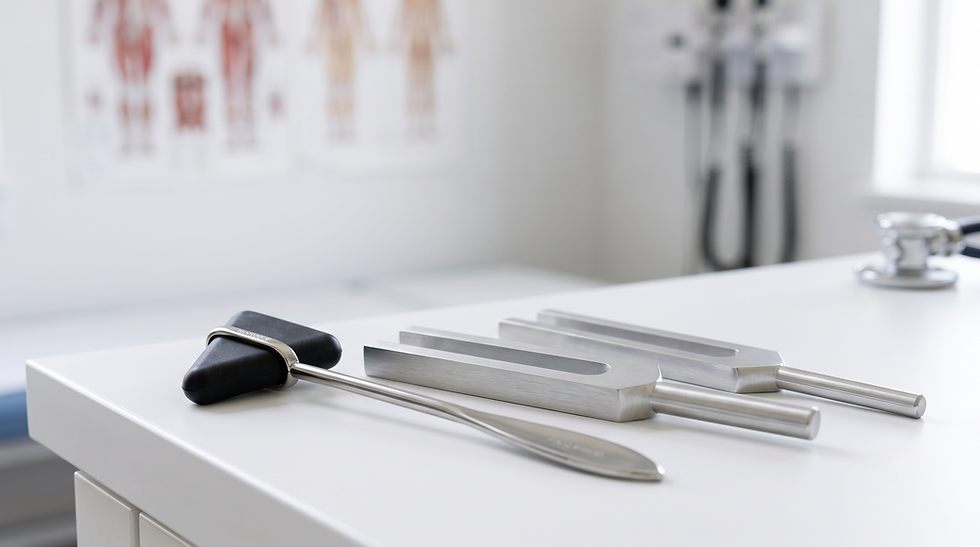
If you're heading into clinical practicals, these two small instruments — a reflex hammer and a tuning fork — will show up in almost every neurological examination you perform. They look simple, but using them correctly, and interpreting what you find, takes practice. This guide walks through the basics so you can walk into your next practical exam with confidence.
The Reflex Hammer: Testing Deep Tendon Reflexes
A reflex hammer tests deep tendon reflexes (DTRs) — the involuntary muscle contraction that happens when a tendon is briefly stretched. This tells you whether the reflex arc, from sensory nerve to spinal cord to motor nerve, is functioning normally.
The most commonly tested reflexes:
Biceps reflex — tests the C5–C6 nerve roots
Triceps reflex — tests the C7–C8 nerve roots
Patellar (knee-jerk) reflex — tests the L2–L4 nerve roots
Achilles (ankle-jerk) reflex — tests the S1–S2 nerve roots
Technique basics:
Make sure the patient (or, in practice sessions, your model or partner) is relaxed — a tense muscle will blunt or exaggerate the reflex.
Locate the tendon by palpation before you strike, so you know exactly where you're aiming.
Use a brisk, controlled wrist-flick motion rather than a stiff-armed swing — the hammer should fall onto the tendon almost under its own weight, guided by your wrist.
Compare left and right sides. Reflexes are graded on a standard 0–4+ scale, where 2+ is considered normal, 0 is absent, and 4+ indicates a hyperreflexive, possibly clonus-involved response.
A common beginner mistake is striking too hard or too soft rather than finding a consistent, moderate tap — reflex testing is about consistency between sides, not maximum force.
The Tuning Fork: Testing Vibration Sense and Hearing
A tuning fork (most commonly 128 Hz for vibration sense, 512 Hz for hearing tests) is used in two very different parts of a neurological and ENT exam.
Vibration Sense (Neurological Exam)
Strike the tuning fork gently against your palm or a firm surface to set it vibrating.
Place the base of the fork on a bony prominence — commonly the interphalangeal joint of the big toe, the wrist, or the medial malleolus.
Ask the patient to tell you when they stop feeling the vibration.
Compare the timing and sensation between limbs, and against your own perception as a control if needed.
Diminished vibration sense, especially starting distally in the feet, is a classic early sign checked for in conditions affecting peripheral nerve function.
Hearing Tests (Rinne and Weber)
Rinne test: Strike the fork and place it on the mastoid bone (bone conduction) until the patient stops hearing it, then immediately move it next to the ear canal (air conduction). Normally, air conduction is heard longer than bone conduction — this is a "positive" Rinne test.
Weber test: Strike the fork and place it on the midline of the forehead or top of the skull. Ask whether the sound is heard equally in both ears, or louder in one — lateralization to one side can indicate either a conductive or sensorineural issue on that side, and is interpreted together with the Rinne result.
Together, Rinne and Weber tests help distinguish between conductive and sensorineural hearing loss — a classic pairing in both audiology and general clinical exams.
Practice Tips for Students
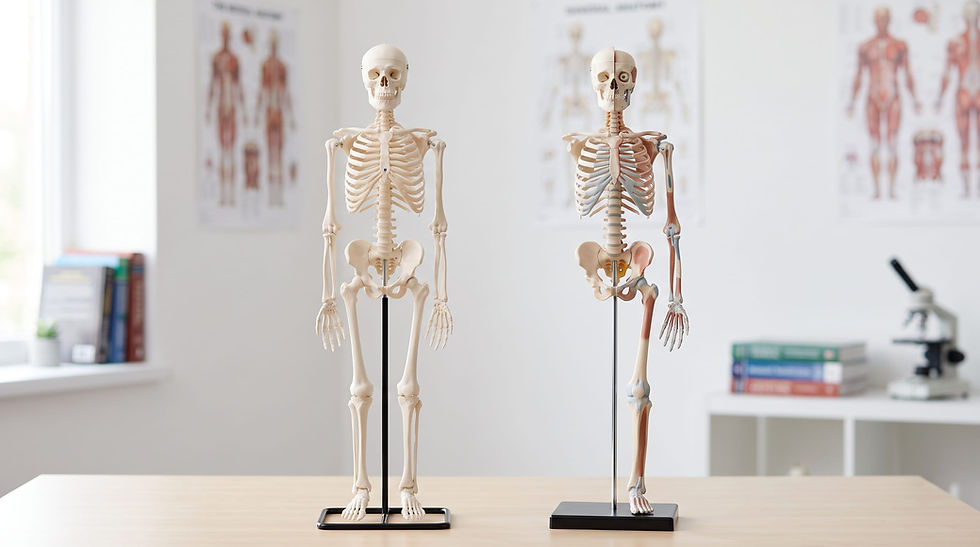
Practice on classmates or anatomy models before your first patient-facing session — the wrist-flick technique for the reflex hammer especially takes repetition to get consistent.
Keep your tuning fork clean and store it away from other metal tools that could nick the tines, since dents affect the frequency and vibration quality.
Learn the grading scale (0–4+) cold — examiners frequently ask you to grade a reflex on the spot, not just elicit it.
XBONZ supplies reflex hammers, tuning fork sets, and other diagnostic instruments alongside anatomically accurate skeleton models for medical, nursing, and allied-health students and institutions across India, the United States, and Europe.


Comments